The East Half
LETTER ONE · JUNIPER SPRINGS
Sunday evening, Letter One
Rosewood House
Juniper Springs, Virginia
Dear Friend,
The first resident of Juniper Springs to enter my car without permission was a beagle.
He had his front paws on the back seat, his back paws on the wet gravel, and his entire head inside the paper bag that held what remained of my turkey sandwich. Behind him, a man I had never met stood inside the other red door, looking at my printer beneath his front window and a box marked WEDDING LINENS in the center of his rug. One of the movers waited on the porch with a floor lamp tilted across his shoulder. Everyone except the dog appeared to understand that something had gone wrong.
You would have noticed the wrong door first. I know this because you once found my missing glasses on my own face and waited eleven full seconds before telling me. I noticed the dog.
“Excuse me,” I said to him.
The beagle backed out of the car with a strip of waxed sandwich paper stuck to his nose. One black ear flopped forward. One brown ear stayed up. He looked pleased with the arrangement.
“That is not your lunch.”
He sneezed the paper onto my shoe.
So. Juniper Springs is going well.
I promised I would write every Sunday, even if I had nothing dramatic to report. I have been here for less than three days and already possess a dog-related grievance, a stranger’s packing tape, and a key to the east half of a house whose east half I failed to identify. I assume this qualifies.
The rain had stopped twenty minutes before I reached town on Friday, but every tree was still dripping. The road narrowed after Greyson and ran beside a creek the color of weak coffee. My phone announced that I had arrived while I was passing a field with six cows and no visible human structure. Then the road bent, and Juniper Springs gathered itself around me: a brick post office, a hardware store with green awnings, a white church beyond the square, and porches deep enough to hold chairs without pretending anyone had time to sit in them.
Miss Bea had drawn a rosewood-red line across the newcomer map she mailed me. I missed one turn anyway. The map is folded in here, and you may inspect my route if you need evidence that I can get lost in a town with one traffic light. The penciled loop beside the church is mine. The firm arrow pointing back toward Rosewood House is hers.
The church sits just east of the square, white brick with dark green doors and a low sign that reads JUNIPER SPRINGS COMMUNITY CHURCH. There were hydrangeas bent under the rain beside the steps. I slowed down long enough for the car behind me to slow down too, which is how I learned that people here will wait politely while you stare at landscaping but will not understand why you are doing it.
Rosewood House appeared at the end of Linden Street behind two climbing roses and a stone walk shining with rain. It is wider than the photograph Dr. Carver sent. The porch runs the whole front of the house. Two red doors sit under the same roof, far enough apart to be reasonable and alike enough to create the afternoon you are now reading about.
I parked by the east walk. At least I believed it was the east walk. The brass-colored tag on my key said EAST in Miss Bea’s square handwriting, and the key opened the door in front of me, so I carried in my camera bag and began directing traffic with the confidence of a woman who had done the bare minimum correctly.
Inside, the east parlor smelled like floor wax, old wood, and the clean damp scent that comes through a screen after rain. The walls are warm white. The fireplace has a rosewood mantel with two small dents near the left corner. In the kitchen, someone had left a blue enamel table beneath the window and placed a card exactly in the center of it.
WELCOME TO ROSEWOOD, the card said. The pipes knock but are not in distress. The third porch step complains and has earned the right. Do not put hot pans on the blue table. Call before deciding an old-house noise is a ghost. —Bea Caldwell.
Her phone number was underlined twice. I read the card again, propped it against the coffeemaker, and decided you needed to meet the woman who wrote it. It is enclosed so you can form your own premature opinion.
The movers brought in the sofa, two lamps, four boxes of books, and the bin of towels. The other red door was unlocked. One of them put his hand on its knob and asked whether I wanted the remaining three boxes in “the other front room.” I said yes because I thought he meant the other room in my apartment. He meant the other front room in the other apartment.
This distinction became clear when a dark pickup turned into the drive and the beagle launched himself from the passenger side before the man behind the wheel had both boots on the ground.
The man took in the open hatch of my car, the movers, and his dog’s pursuit of my sandwich. Then he looked through the west door.
“Either Miss Bea has changed her decorating style,” he said, “or I have acquired a printer.”
I followed his line of sight. My printer sat beneath his front window. Beside it was a hard case of camera equipment and, in the center of his rug, the box.
WEDDING LINENS.
The marker had bled in the rain, but not enough to grant me mercy.
“I’m sorry,” I said.
He set his keys on the little table inside his door. “For the printer or the linens?”
“The whole occupation.”
“It has been bloodless so far.”
The younger mover came up behind me carrying a floor lamp. “Ma’am, where do you want this?”
The younger mover turned where I pointed. The lampshade slid sideways and covered half his face. He kept walking.
“I’m sorry,” I said again, this time to the stranger whose living room I had furnished.
He looked at the box in his parlor, then at me. Rain had darkened the shoulders of his blue shirt. His sleeves were rolled, and there was a fountain pen clipped inside one pocket. His hair had surrendered to the weather. I did not notice that he was handsome. I noticed those entirely separate facts and assembled nothing from them.
Please behave yourself.
“The doors confuse delivery people,” he said. “And one substitute mail carrier.”
“That does make me feel better.”
“It wasn’t intended to.”
The corner of his mouth moved before the rest of his face did. Not a smirk. More like he had offered the joke and was willing to let it sit there without insisting I admire it.
The driver checked the time on his phone. They had another delivery in Greyson and could move the printer, but not the boxes upstairs before they left. Before I could begin apologizing in a third direction, the stranger bent to the camera case and stopped with his hand above the handle.
“May I?” he asked.
My hand loosened on the camera strap. Most people see a hard case and assume hard means indestructible. I nodded.
He tested the weight before lifting it. “East parlor or upstairs?”
“East parlor. Against the inside wall, please.”
“Temporary studio?”
“Temporary everything.”
The answer came out too fast. He shifted the case against his leg but did not ask what I meant.
“Graham Dawson,” he said instead. “West half. History at the academy.”
“Abby Harper. East half. Photography at the academy, apparently with an early concentration in residential invasion.”
“Dr. Carver said the new teacher would arrive this week.”
“Did she warn you about the linens?”
“She tends to save the important details for faculty meetings.”
Franklin barked from my car.
“And that is Franklin,” Graham said. “He believes an open door is a character reference.”
By then Franklin had moved on from the sandwich bag and was sniffing the canvas tote that held my road snacks. Graham said his name once. The dog froze, considered the quality of their relationship, and climbed the rest of the way into my car.
I laughed hard enough that Franklin looked offended. Graham closed his eyes for one second, walked to the car, and lifted him out with the practiced resignation of a man removing a casserole from an oven.
“Your recall training is impressive,” I said.
“We’re emphasizing independent thought.”
Franklin licked his wrist.
The movers left six minutes later. Graham and I stood on the porch with three boxes between us while water tapped from the gutter into a metal bucket near the steps. A moving truck is noisy enough to keep embarrassment from settling. Its absence is not.
“You don’t need to help,” I said.
“I know.”
He picked up the printer.
The first box held photo paper and mats. The second held cords, spare batteries, and a portable light stand that tried to unfold halfway across the porch. We caught one end each. Graham’s knuckles knocked mine against the metal pole, and both of us kept holding it because dropping several hundred dollars of equipment would have been a stupid way to acknowledge a hand.
“There’s a latch,” he said.
“I know.”
“You’re holding the latch.”
I looked down. I was.
“This move has not displayed my full range.”
“I assumed there were additional skills.”
We folded the stand and carried it into the east parlor. He placed it exactly where I pointed, then shifted the printer two inches so the cord could reach the outlet without stretching. He did not announce that he had noticed the outlet. He simply made room for the thing to work.
The last box stayed on his rug until everything else was inside my apartment.
WEDDING LINENS waited in the west parlor with the patience of an unpaid bill.
“That one can go upstairs,” I said.
Graham bent for it, then paused. “Still all right for me to carry?”
The tape across the top had gone soft at one edge. I pressed it down with my thumb. “Yes. It’s only fabric.”
He nodded once. No question. No careful little “oh” for me to manage. He carried the box up the narrow stairs while I followed, watching the damp heel marks his boots left on the runner.
At the bedroom door, he set it down gently.
“Anything else in my house?” he asked.
“Not unless you find a box labeled POOR DECISIONS.”
“I’ll check the attic.”
Then he went downstairs to retrieve his dog.
Apparently I can photograph three hundred people crying at weddings and still be defeated by one box labeled WEDDING LINENS in black marker.
I left it unopened until Saturday afternoon. It sat at the foot of the bed while I shelved mugs, made the blue table hold a coffeemaker, and found six lens caps in places no lens cap had any reason to be. When I finally cut the tape, the smell of cedar and clean cotton came up from the box.
Inside were twelve ivory napkins, two table runners, and the linen handkerchief my mother had given me to carry. None of it was used. That is the factual description.
The less tidy description is that Grant and I had chosen the napkins on a Saturday when he was already answering questions about the wedding as if someone else had scheduled it. I remember running my fingers over the hem while he stood beside me reading an email. I asked cream or white. He said either. I asked linen or cotton. He said linen sounded fine. I asked whether he still wanted the outdoor tables, and he kissed the top of my head without looking up.
Three months later, at our kitchen counter in Richmond, he told me he had accepted a position that would keep him traveling. He had wanted that kind of life for a long time. He had also known for a long time that he did not want the one we were ordering in deposits.
There was no affair for me to uncover. No terrible sentence I could repeat until everyone agreed he was a villain. Just a paper coffee band he rolled tighter and tighter between his fingers while I tried to understand how a person could be honest on a Tuesday about something he had let me plan around for months.
Seven months have passed. I kept the linens because deciding what to do with them required opening the box, and I had become very good at walking around it.
I did that with more than the box. I stopped taking weddings but told clients I was booked, edited portraits until skin stopped looking like skin, and stayed late in the studio because the apartment was too quiet, then complained that work had taken over my life. Richmond became a room I kept circling instead of crossing.
Dr. Carver’s offer arrived in the middle of that: twenty-four weeks teaching photography at Juniper Springs Christian Academy, housing included. Temporary enough to be safe. Real enough to call it work instead of escape.
That is what I told you when I accepted it.
It was true. It was not all of the truth.
The rest is that I wanted to go somewhere nobody had seen our engagement pictures. I wanted to introduce myself without watching a person decide whether to ask about Grant. I wanted one room where the future had not already been measured for furniture.
Saturday evening, after I closed the linen box, I carried one lamp upstairs and switched it on beside the front bedroom window. The rain had left the sky pale over the ridge. On Graham’s side of the house, an upstairs window brightened too.
I took my camera outside.
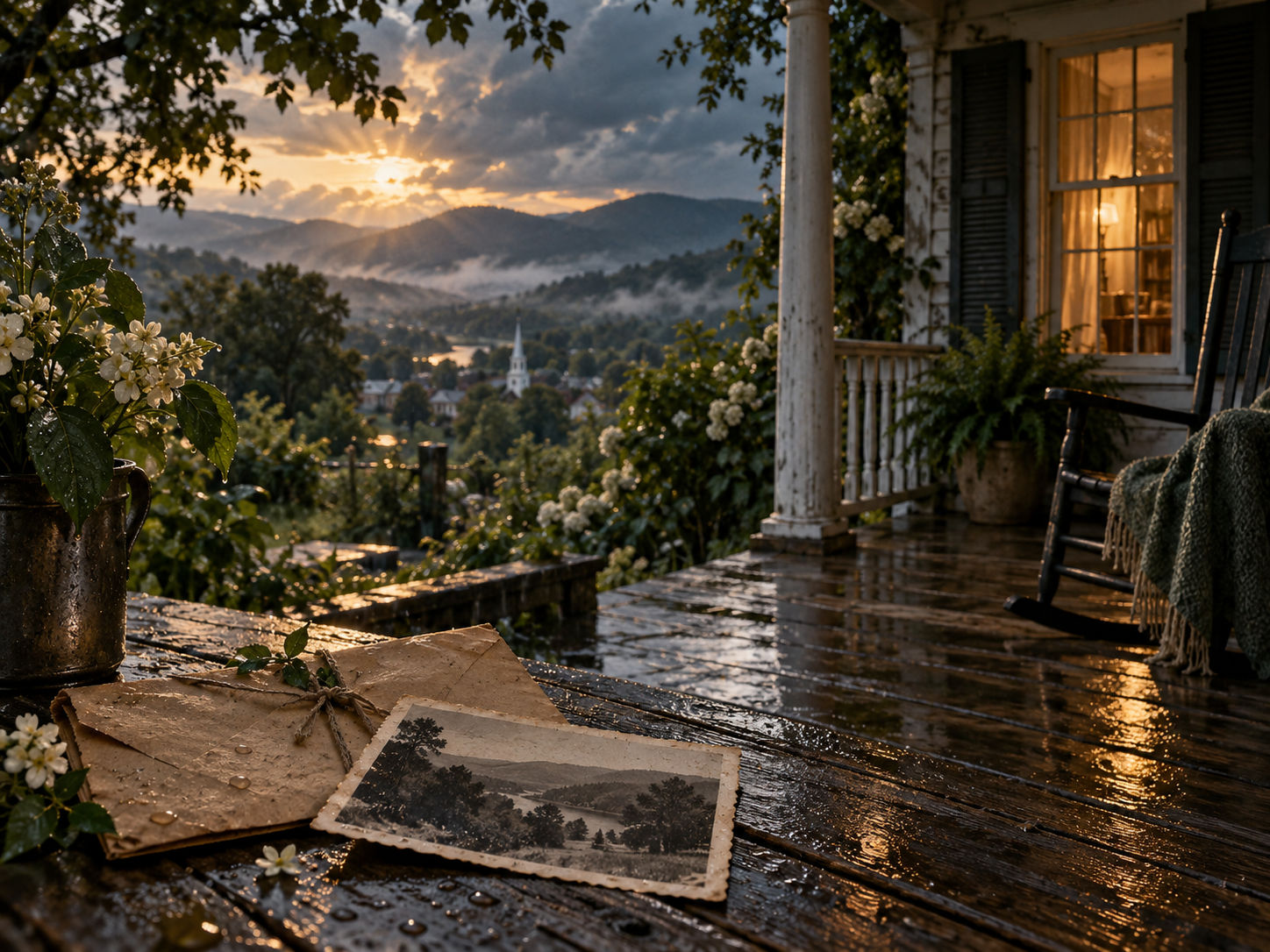
From the road, Rosewood House did not look divided. The porch ran beneath both upstairs windows. Wet leaves shone against the foundation. The two doors held their red even in the flat light, and one upstairs window glowed on each side. I made three frames, stepped two feet left, made two more, and stood there until a drop from the maple above me slid down the back of my collar.
The photograph in this envelope is the fifth frame. I printed it this afternoon on the same printer that spent twenty-seven minutes living with Graham. I wanted you to see the house before my boxes teach it all my bad habits.
Miss Bea’s spare EAST tag is in here too. She wrote the move-in date on the back and left the key separately because, in her words, “We are not mailing metal if paper will do.” You will also find her welcome card and the map. I marked the academy, the church, and the place where I turned around beside a mailbox shaped like a trout. That mailbox does not appear on Miss Bea’s official map, which feels like an oversight.
This morning I knew what time church started because she had circled it in green pencil. At nine forty-five, cars began passing the kitchen window and turning toward the square. I stood at the sink in my pajamas with coffee that was mostly cream and watched them go.
I did not go.
The ceiling fan clicks once above me, and there is cardboard dust stuck to the inside of my arm.
I still believe in God. That part did not vanish when the wedding did. I still thank Him for safe drives and other people’s babies and test results that come back clean. My prayers have become broad enough that nothing in them can disappoint me. Bless everyone. Help with everything. Thank You for whatever You are doing that I cannot currently identify.
Very efficient. Almost no risk.
This morning I nearly asked whether coming here was right. The question reached the back of my teeth and stopped. I rinsed my cup, turned Miss Bea’s map face down, and unpacked the rest of my lenses instead.
Maybe next Sunday I will go. That is not a promise, and you are not allowed to turn it into one in your return letter.
The blue table has a scorch mark near the sugar bowl despite Miss Bea’s warning about hot pans. My coffee is cold. The third porch step complained twice a few minutes ago, followed by Franklin’s nails crossing the boards. He has spent most of today testing the exact legal boundary between his side of the porch and mine. So far he recognizes no governing authority.
A minute ago, Graham said something I could not hear through the wall. Then he laughed—one surprised sound, low and brief—and Franklin’s tail thumped the baseboard three times.
I kept the pen lifted above the paper until all three thumps stopped.
So that is the first week. I have a contract, an east door, four unpacked boxes, and a neighbor I cannot crop out.
I think you are going to like it here.
Love,
Abby
P.S. Franklin has just sneezed outside my door. I am choosing to interpret this as an apology.